For everyday use, a 600–750 mL bottle (about 20–25 US fl oz) is a practical starting point. Choose 350–500 mL when compact carrying matters and refills are easy. Consider around 1 L when fewer refills matter more than a smaller bottle.
These are starting points, not rules. The right water bottle depends on the time between refills, how you carry it, and where it needs to fit. You do not have to carry your entire day’s drinking water in one container.
Water Bottle Size Chart: Capacity and Actual Dimensions
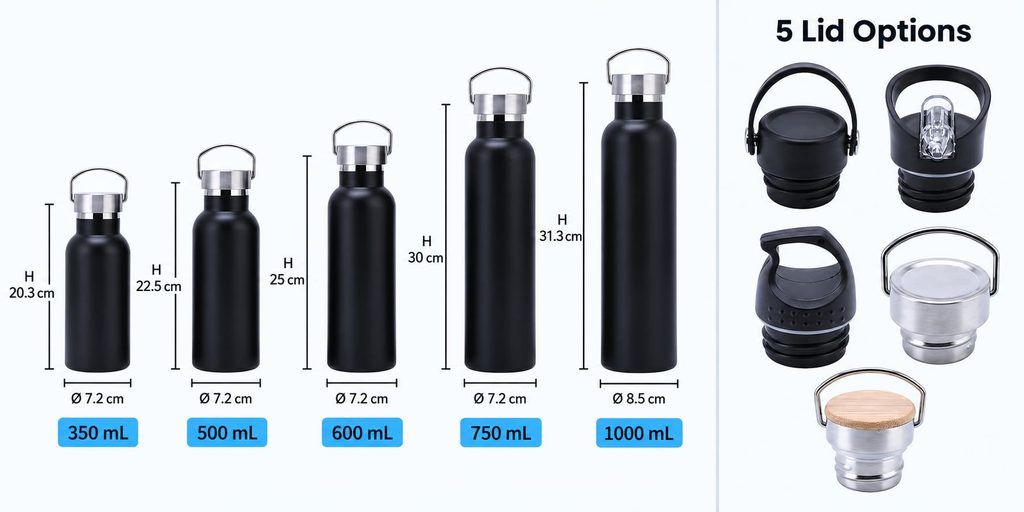
Capacity tells you how much liquid a bottle holds. Height and diameter tell you whether it will fit your routine. This multi-size stainless steel insulated bottle series provides a useful example: the same bottle design comes in five capacities, but each size has different proportions.
| Capacity | Listed height | Base diameter | Main consideration |
|---|---|---|---|
| 350 mL / 12 oz | 20.3 cm | 7.2 cm | Compact option for short outings; more frequent refills |
| 500 mL / 17 oz | 22.5 cm | 7.2 cm | Daily carrying where water is easy to refill |
| 600 mL / 20 oz | 25 cm | 7.2 cm | Middle-ground capacity without a wider base |
| 750 mL / 25 oz | 30 cm | 7.2 cm | More water between refills, but a taller bottle |
| 1,000 mL / 34 oz | 31.3 cm | 8.5 cm | Higher capacity with a wider base |
The dimensions above apply to this series, not every bottle with the same capacity. Check the final overall height with your chosen lid if clearance is important. For other capacities, use our oz-to-mL converter. The ounce values here use US fluid ounces and are rounded.
What Size Water Bottle Works Best for Your Routine?
Work and Everyday Commuting
If you can refill at work, a 500–750 mL bottle is worth considering. Choose the smaller end when bag space matters and the larger end when you dislike interrupting your work to get water. A 1 L bottle may suit a desk-based routine, but consider whether you want to carry it on the commute as well.
School and Children
For children, start with handling rather than maximum capacity. Can they open the lid, hold the filled bottle, and fit it into their school bag? A 350–500 mL bottle may be easier to manage, provided refills are available. Older students may prefer more capacity. The school routine and the child’s ability to carry the bottle matter more than a fixed age-based size rule.
Gym and Exercise
A 600 mL to 1 L bottle offers several starting options. If your gym has a convenient refill point, a smaller bottle may be sufficient for carrying between stations. If you prefer fewer stops, consider 750 mL or 1 L. Choose according to your usual drinking pattern, activity duration, and access to water—not simply because the bottle is labelled for sports.
Travel and Outdoor Activities
Short outings with easy refill access often favour a smaller bottle. Longer trips may justify more capacity, but extra water also means extra carrying weight. For hiking or extended outdoor use, plan around the route and available water sources. Do not assume that a 1 L bottle, or any other single capacity, will be enough for every trip.
Check Filled Weight and Fit Before Choosing
Test the bottle when it is full. A large empty bottle can feel manageable until you add water. If you already own a bottle, use it to judge the weight you are comfortable carrying. When comparing new models, check the bottle’s own weight as well as its capacity.
Measure the space it needs to fit. A car cup holder, backpack pocket, and bicycle bottle cage have different limits. Capacity alone cannot confirm compatibility. Look at base diameter, maximum width, and overall height, including the selected lid.
The size chart gives a clear example. The 1 L version is only 1.3 cm taller than the 750 mL version, but its base increases from 7.2 cm to 8.5 cm. If your bag pocket or cup holder is narrow, the extra width may matter more than the extra height.
Consider the lid too. A carry handle may make a larger bottle easier to move, while a protruding lid can need more bag space. If the bottle will travel inside a bag, check the lid’s sealing instructions rather than assuming every cap option has the same leak resistance.
Frequently Asked Questions
Is a 32oz water bottle too big for everyday use?
Not necessarily. A 32 US fl oz bottle holds about 946 mL, so it is close to the 1 L category. It can work well when you want fewer refills or keep it on a desk. If you carry it for long periods, compare its filled weight and dimensions with a smaller option before buying.
Is a 500mL water bottle enough for a whole day?
It may work for a full day’s routine if you can refill it. However, a 500 mL capacity does not mean that 500 mL is an appropriate daily drinking amount. Choose based on refill access and your individual needs rather than expecting one fill to cover the whole day.
Should I use different bottle sizes for different activities?
You can. A compact bottle may suit commuting, while a larger one may be more convenient at a desk or on an outing. You do not need multiple bottles, but one capacity does not have to be the right choice for every situation.
Choose the Size You Will Actually Carry
The most useful bottle holds enough water between refills without becoming inconvenient to carry or store. If your current bottle is often empty before you can refill it, consider going larger. If it is regularly left behind because it feels bulky, consider going smaller.
For a school, team, or branded bottle project, apply the same checks to the intended users. Confirm capacity, dimensions, and lid choice before approving a sample.